I think it’s still useful, but it should be display as h3cellid, shown on the map with a h3 hex drawn around it, and an optional google maps link to the coordinates. (H3 cellid approximant , lat/lon) as an example.
Further is the h3cellid available via GRPC or only via v2 starlink api?
It’s important that it’s not relied on and look at like accurate gps.
1 Like
@Jonathan_Pitts , The location information is only available via the Starlink API. Could you share more details about your use case and how this information would help with your deployment?
1 Like
@sitloongs We will use in deployment to find asset locations.
Not all of our previous deployments were with peplink that had gps.
Such as b one, br1 mini 5g, br1 mini core.
1 Like
Hi Teams,
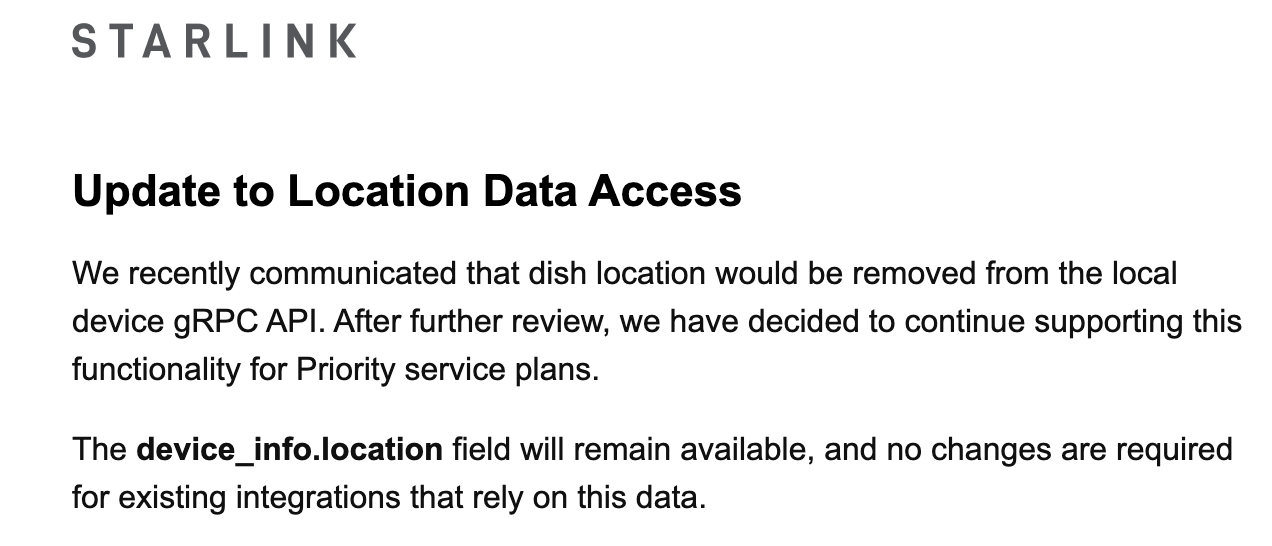
Looks like enough feedback was raised to the Starlink team, and they have decided to continue supporting location data access for Priority service plans.
Could you please check and confirm whether you have also received a similar notification from Starlink?
3 Likes
I haven’t received this yet, what was the subject?
1 Like
Confirmed I received the e-mail and I’ll do some testing later today.
Subject: “Update to Starlink Location Data Access”
2 Likes
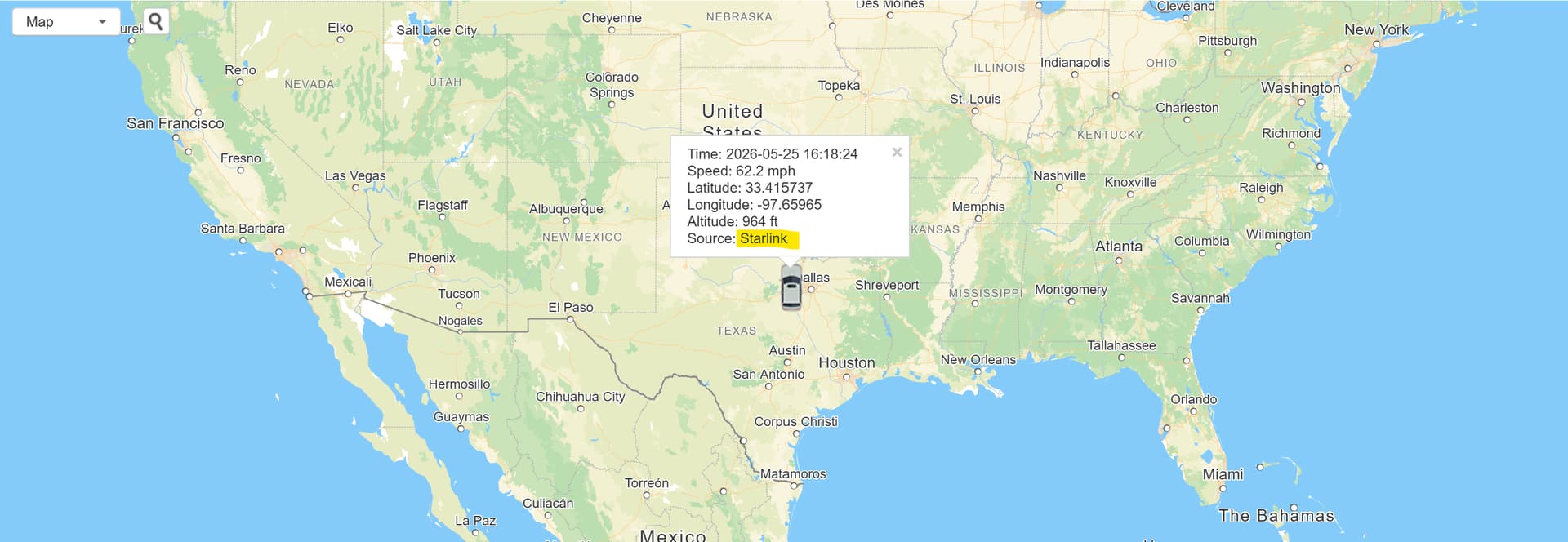
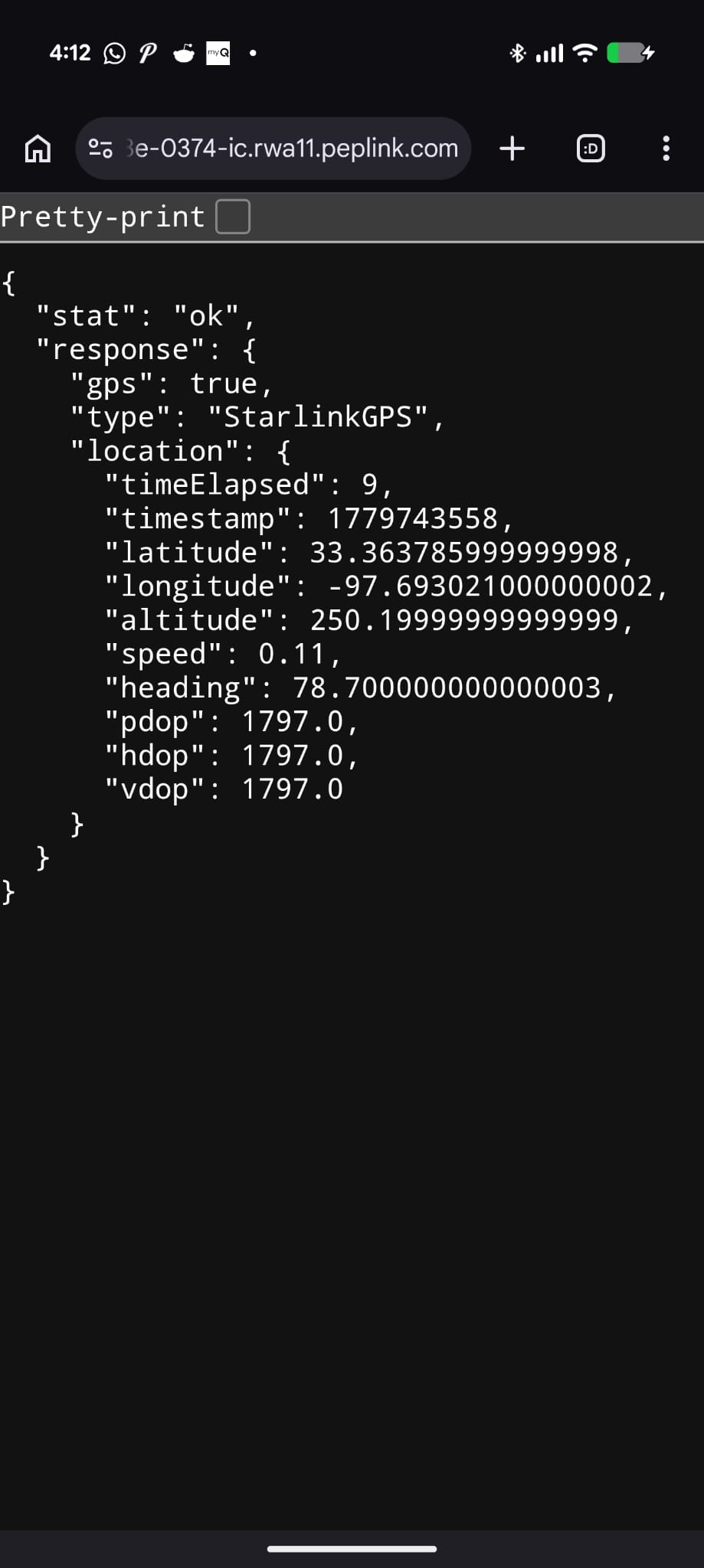
After Starlink disabled the GPS network feed that the B One 5G in my motorhome used, I worked with Claude code to build a fairly low priced GPS module to provide a network GPS data source. I already had a mobility 42g antenna on the roof for the external GPS antenna.
My use case is NOT business critical, so I didn’t want to go with the more expensive service plan.
It works great in my situation, so I put it on Github in case it helps anyone else.
2 Likes
Hello @NovaBandit,
Welcome to the Peplink Community Forum
Thanks for your very constructive solution on the GPS and putting this together, I’m sure other Peplink integrators and users will find this helpful in the future.
Have a good week,
Marcus 
1 Like
Hello @sitloongs
Are there still any plans to pursue the H3 data ingest to Peplink and display/record for location services?
This will still be very helpful to roam accounts, an example of non-priority plans that no longer receive GPS coordinates.
As discussed with the Engineering team, the H3 location is not obtained directly from the Starlink User Terminal (UT). Instead, it is retrieved from the Starlink Enterprise/Management API.
It is important to note that the H3 location is not the terminal’s actual GPS location. The Starlink API returns an H3 Cell ID, which represents the center of an H3 hexagonal cell covering the terminal’s approximate location. As a result, the reported location is only an approximation and differs from the Peplink GPS feature, which reports the device’s actual GPS coordinates.
Since the Starlink API does not provide the UT’s exact GPS coordinates, the Engineering team currently has no plans to implement this feature. Users who require the H3 location information can already obtain it through the Starlink Enterprise/Management Portal.
2 Likes