OK, so a bit of a baity headline, but we all know the internet is basically a war zone right now.
Peplink, I think you were a bit slow on CVE-2026-98432 given how many devices it affects across the product range. “We are investigating…” with two days of silence for such a large vuln isn’t great. I do appreciate and assume that the engineering team at Peplink was working extremely hard to get all of the necessary builds created and QA’d, but comms to distributors or partners about what’s coming and what the status is will be critical as the internet becomes more of a war zone.
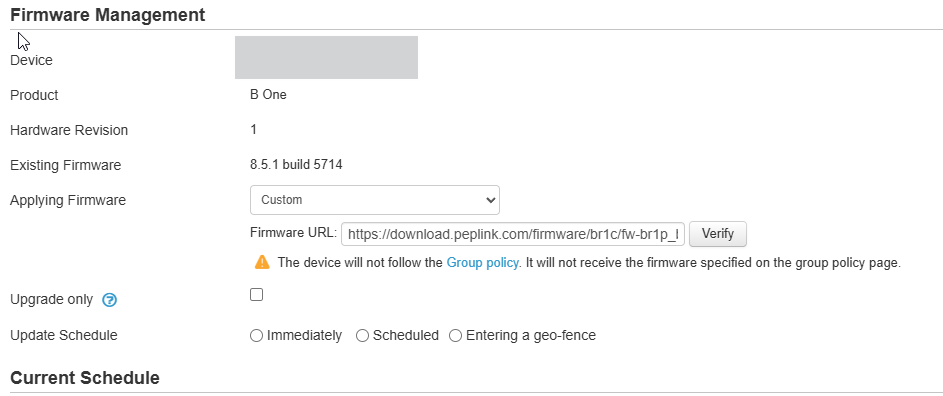
More importantly, we (network/system admins) need a scalable and/or scriptable way to apply firmware updates. It is painful to update custom firmwares across many subsets of devices across organizations. When you’re a partner that manages dozens to hundreds of organizations and pretty much every product across the spectrum, it’s daunting! But hey, I never complain without a recommendation or offer for help
I think there are two possible solutions that aren’t necessarily mutually exclusive:
Special builds should not be used for rapid security releases. Semantic versioning principles state that builds should be [major].[minor].[patch], but Peplink uses the Patch tuple as more of a sub-version, which is cool. However, as you did with ICVA releases for these patches, you can use a fourth tuple to push a “new” version and allow it to be selectable in the dropdown in InControl2
Expose an IC2 API endpoint (I couldn’t find one in the docs) to update firmware for orgs, groups, and individual devices. I understand this is not a small effort given exceptions, validations of custom firmware URLs, scheduling, etc., but again, the internet is a warzone. It’s only a matter of time before some vulnerability is discovered that is widely exploited and affects Peplink devices (among everything else), and patching in minutes via API and scripting versus hours of point and click, copy and paste, will actually make a difference.
Editing to add some thoughts around special builds:
Special builds are just that: special. It is not (nor should it be) “special” to patch a CVE. When a user open a box and updates the firmware to the latest version they should be confident in the generally understood fact that “latest version” has all of the latest features, fixes, and security patches. By using a special build, you are requiring a user to 1) know about and 2) find a special build/release, but most importantly, 3) know how to install it.
Imagine if you have a new user who purchased your device and upgraded using IC2 or the local device admin to the “latest” version, only to be compromised by a security vulnerability that required them to find and download from a forum post to patch against. Not great.
This is an extremely common occurrence we see. Users simply use the built in firmware update to check for any updates and if nothing is returned, they expect they are on the latest with no further investigation. Nor should they be expected to at that point.
Special build postings in the forum require the user to first be aware there is an issue and all too many users are oblivious to vulnerabilities as it isn’t their realm to stay in the know.
I love the idea of a fourth tuple! This would’ve been helpful a few times in the past that I can recall.
I agree. Both are very good suggestions. Our team will look into that.
Looking back at how we handled this one, I also agree that we can do a better job of communicating and keeping the community informed of the latest status. Next time when we learn that we are impacted by a CVE, we should issue a first advisory as soon as possible with mitigation strategies while a permanent fix is being built. Customers should have the choice to disable services in exchange for security, and be told about that trade-off. This is the mindset we are taking going forward.
Keith, thank you VERY MUCH for that response. As always, if there is anything myself or the Llama team can do to help the Peplink team here, we’re standing by.
Just to chime in here, we would also benefit from these special firmware builds for security releases being available for installation directly on the firmware policy page in InControl2. The issue we face now is that the only way to apply these special builds is to log into each router manually and run the firmware update directly on each device. This does not allow scheduling the update to be applied at specific time. Our business is open normal business hours during the week, and manually updating routers means scheduling with each of our clients to take them offline for a period of time during their workday. We would love to be able to schedule the security patch firmware version directly in InControl2 Firmware Policy so that these can install overnight when our clients are closed. Right now we are almost forced to not apply security patches until the next GA release due to the downtime and coordination needed to update each router manually with the special firmware builds.