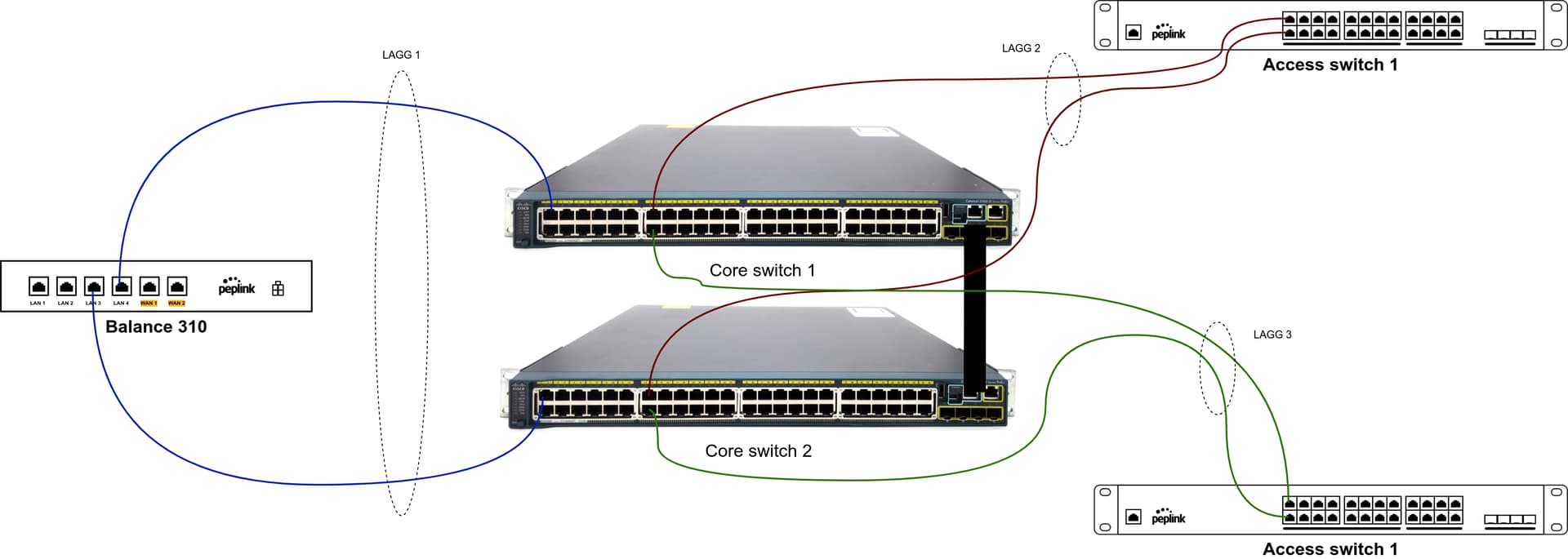
When adding an additional B310 in HA, this would result in full hardware redundancy: any component may fail without having an impact on the performance and reliability of the core network.
Is it possible to achieve more or less the same redundancy and performance with Peplink rugged switches as core switches? Their performance is great, but unfortunately they are not stackable. I was thinking of using RSTP to solve this issue, but the B310 doesn’t run RSTP on its LAN interfaces as it’s not considered to be a switch.
Are there any other possiblities to achieve full core hardware redundancy in the Peplink ecosystem? Thanks.
We have been looking at the same as we are looking for a enterprise type redundancy level on our vessel based platforms. Unfortunately without success.
Hello @PeterDedecker
We have been using the Peplink 2.5G Rugged SD-Switches for the High Availability you asked about. The difference is that we are using the Peplink Balance 1350EC model for the routers as a minimum; this way, not only are all the Peplink devices redundant, but each device also has redundant power (two independent power circuits).
I more or less solved this by connecting every B310 on its trunk port to exactly one Peplink rugged switch. This way, either a B310 or a switch could fail without having a major impact. A switch failure results in the connected B310 being isolated, and the slave takes over. A failure of the master B310 results in the slave taking over without any impact at all.
It’s of course a bit a pitty as this way you can’t benefit the additional capacity of an additional 10 Gbps link to the second switch, but 10 Gbps is already quite nice. Having RSTP on the B310 (and other devices) would be very nice.
I have done that, but it gets messy fast if you have to many switches. Two peplinks in HA, and then 3 or 4 extra switches and you have no way of making it resilient without relying far to much on RSTP. Our biggest network with peplink switches has close to 150 peplink switches, all of which are connected via LACP using two ports to the core. The core is 7x Extreme Networks 7520’s running in fabric mode, so that’s very very redundant and it works well.
RSTP can’t be used at much scale for this sort of thing, because every port state change (up or down) for a port that is not an edge port causes an STP topology change notification to all switches and they flush their mac table and that causes lots of TCP resets.